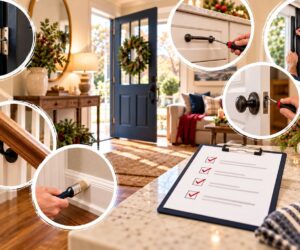
Short answer: Hurricane season ends November 30. Sarasota and Bradenton homeowners should then check shutters and their hardware before storing them, clear the gutters, and look over caulking, weather stripping and trim. This Handy Brit checklist covers what to inspect on a Florida home, what you can handle yourself, what the work costs, and why December is the easiest month of the year for outdoor repairs in Southwest Florida.
On November 30, the Atlantic hurricane season officially comes to an end. For most of us that means the same small ritual: the shutters come down, the panels go back into the garage, and we stop checking the forecast three times a day.
Then the outside of the house gets forgotten about until hurricane season comes back around in June.
That is the part worth changing. Your home has just been through a full hurricane season of heat, humidity, driving rain, and wind. None of it has to be a named storm to leave a mark. Caulk shrinks. Weather stripping flattens. Gutters fill. Trim softens where water has been sitting against it. None of it looks urgent, which is exactly why it gets ignored until it becomes a much bigger repair.
I am Paul Wright, owner of The Handy Brit. I have been looking after Sarasota homes since 2017, and the end of hurricane season is one of the two or three times a year I think it is genuinely worth walking the outside of your house on purpose. Here is how I would do it.
Once hurricane season is behind you, walk the outside of the house slowly, in daylight, after a dry couple of days. Work in this order:
If you only do one of these, do the shutters. The rest will wait until spring. The shutters will not, because the problem with them does not show up until the week you need them. If the whole list looks like more than one Saturday, our half-day and full-day handyman packages are built for exactly this kind of list.
The Atlantic hurricane season runs from June 1 to November 30. Those dates are set by NOAA’s National Hurricane Center and they bracket the period when the overwhelming majority of Atlantic storms form.
The honest caveat is that storms do not read the calendar, and off-season systems have formed before. But November 30 is the practical point at which most Southwest Florida homeowners take the shutters down, and it is a sensible annual marker for getting the outside of the house back in order.
It also lines up with the nicest working weather we get all year. December through March is when outdoor jobs in Sarasota are actually pleasant, which matters more than it sounds when the job involves a ladder.
More than stack them in the garage, which is what usually happens.
What to check: that you still have every panel. That each one is labelled for the opening it covers. That the wingnuts, bolts, and anchors are all present and not seized with corrosion. That the tracks and headers on the house are clear and undamaged. That accordion and roll-down units still run smoothly along their full travel. That panels are stored flat and dry rather than leaning in a corner where they can warp.
What can be done: missing or corroded hardware is cheap and easy to replace now and almost impossible to find the week a storm is named. Anchors that have pulled loose need refixing into something solid. If your panels are aging, heavy, or you are tired of wrestling them, polycarbonate shutters are lighter, let daylight through, and are considerably easier to put up single-handed.
The reason to do this in December rather than next May is simple. In December it is a job. In May, when everyone else has remembered at the same time, it is a queue.
Six months of rain moves a lot of debris into places it should not be.
What stands out: gutters holding standing water or sprouting things. Downspouts that discharge straight against the foundation. Sections pulling away from the fascia. Staining on the wall below a joint, which usually means it has been overflowing all season. Soffit panels that have slipped or that show water marks.
What can be done: gutter cleaning is straightforward and makes an immediate difference, and it is far easier to assess what is actually wrong with a gutter once it is empty. Resecuring loose sections, adding or extending downspout runs, and dealing with the exterior repair around a chronic overflow are all normal end-of-season work.
A full gutter is not just a gutter problem. It is where fascia rot, stained walls, and wet soil against the slab usually start.
A hurricane season is unkind to both, and this is the least glamorous and most useful item on the whole list.
What stands out: caulk that has cracked, shrunk back, gone chalky, or pulled away from the joint around windows, door frames, trim, and where dissimilar materials meet. Weather stripping that has compressed flat, gone brittle, or no longer makes contact when the door is shut. A door you can see daylight around. Rooms that feel noticeably warmer than the rest of the house.
What can be done: failed caulking is quick to cut out and redo, and it is doing two jobs at once by keeping water out and conditioned air in. Replacing weather stripping and thresholds is one of the few repairs that pays you back on the electricity bill every month afterwards. Inside, failed grout and bathroom caulk are worth the same attention for the same reason.
Everything that moves has spent a hurricane season expanding, contracting, and collecting grit.
What stands out: a sliding glass door that has to be shouldered along its track. Windows that will not stay up, or that are harder to open on one side. Exterior doors that stick, drag, or no longer latch without a push. Screen panels on the lanai that have torn or come loose from the spline. Hinges and locks showing corrosion.
What can be done: sliding glass door rollers are one of the most common repairs we do in this part of Florida, and the fix is usually faster than people expect. Window balance springs are what is wrong when a window will not hold itself open. Sticking doors often come right with a hinge adjustment, a planing, or a rehang rather than a replacement.
This is where a Florida wet season shows itself most obviously, and where the drier months are genuinely the right time to act.
What stands out: mildew and algae streaking on walls, especially on the north side and anywhere shaded. Green film on the driveway, walkway, and pool deck. Paint that has gone chalky to the touch. Wood trim and fascia that feels soft when you press it. Rust streaks from fixings. Screens and railings that have dulled.
What can be done: pressure washing usually makes a bigger visual difference to a Southwest Florida home than anything else you can spend the same money on. Soft trim needs replacing rather than painting over, because paint on rotten wood is just a slower version of the same problem. Once surfaces are clean and sound, painting in the dry season gives you the best possible conditions for it to cure properly.
A fair amount of it. Counting and labelling shutter panels, bagging the hardware, extending a downspout, and looking over caulk lines are all reasonable Saturday jobs and you do not need us for them.
Where it changes is anything involving a ladder and a roofline, anything structural, and anything where the repair depends on knowing what is behind the surface. Gutter work at height, refixing anchors into block or framing, replacing rotten fascia, and rehanging a door are the jobs that most often turn a weekend into a fortnight.
The honest version is the same as it always is. The deciding factor is rarely skill. It is whether you want to spend your Saturday on a ladder, and whether you own the thing the job needs.
A post-hurricane-season list is almost always a collection of small jobs rather than one big one, so we price it by time rather than by item. Our handyman service packages are built for exactly this kind of list:
Additional package time is billed at $95 per hour, with your approval. Materials are billed separately. You are welcome to supply your own, or we can supply them at cost plus a 30% procurement and handling fee. Full details are on our pricing page.
Estimates are free. Send us your list and some photos and we will tell you honestly whether it is a half day or a full day rather than sell you the wrong one.
We work from your list, and most of these smaller jobs can be grouped into a single visit. How much fits depends on the work, the parts, and the time booked. Some customers call it a honey-do list, which is exactly the right description. In practice it means:
We back every job with a 12-month labor guarantee. We are veteran owned, carry $1,000,000 in general liability insurance, and are rated 4.9 stars across more than 250 customer reviews. If you would rather see the work than read about it, our before and after gallery is the honest version.
If the holidays are the next thing on your calendar, our guide to getting your home ready for holiday guests picks up where this one leaves off and covers the inside of the house. And if you would rather stay ahead of all of it year-round instead of catching up twice a year, Month by Month Home Care exists for that.
Make the list. We will take it from there.
Free estimates. Serving Sarasota, Bradenton, Lakewood Ranch, Siesta Key, Longboat Key and Anna Maria Island since 2017.
Through November 2026, we are donating $40 from every Full-Day Package and $20 from every Half-Day Package to the SRQ Vets 8th Annual Toy Drive & Breakfast.
The Atlantic hurricane season runs from June 1 to November 30, according to NOAA’s National Hurricane Center. Storms can form outside those dates, but November 30 is the practical point at which most Southwest Florida homeowners take shutters down and get the outside of the house back in order.
Count every panel, label each one for the opening it covers, and bag the wingnuts, bolts, and anchors together so nothing goes missing. Store panels flat and dry rather than leaning, which can warp them. Replace any corroded hardware now rather than the week a storm is named, when it becomes very hard to find.
Start with shutters and their hardware, then gutters and downspouts, then caulk and weather stripping around windows and doors. After that check that doors, windows, and sliding doors still operate properly, and look over exterior walls and trim for mildew, chalky paint, and soft wood.
Usually yes. In Southwest Florida gutters collect roof grit, shingle granules, blown sand, and plant debris from well beyond your own yard. A gutter that overflows all season is where stained walls, soft fascia, and wet soil against the slab tend to start, and the problem is much easier to assess once the gutter is empty.
It is almost always the rollers, the track, or both. A season of grit and moisture wears rollers down and packs the track, and the door starts needing a shoulder. It is one of the most common repairs we do in this area and usually faster to fix than people expect.
The Handy Brit prices small-job lists by time rather than per item. A Half-Day Package is $350 for up to 3.5 hours and a Full-Day Package is $650 for up to 7 hours, with additional time at $95 per hour. Tools and cleanup are included; the full-day package also includes ladders and workspace protection. Materials are extra, and estimates are free.
Yes. We cover Sarasota, Bradenton, Lakewood Ranch, Siesta Key, Longboat Key, Anna Maria Island, Lido Key, University Park, Osprey and Parrish.
About the author
Paul Wright is the owner of The Handy Brit, a veteran-owned handyman company serving Sarasota, Bradenton, Lakewood Ranch, Siesta Key, Longboat Key and Anna Maria Island since 2017. A British Army veteran, Paul moved to Southwest Florida and built the company on the same standards he was trained to. The Handy Brit has been awarded Best of Florida, is a certified Nest Pro Installer, and backs its labor with a 12-month warranty. Paul is also President of BNI Power Connections in Southwest Florida. Read his story or see the work.

Awarded Best of Florida
Local Veteran Owned and Operated
12 Month Labor Warranty
Nest Pro Installer
workers compensation exemption
$1,000,000 General Liability Insurance
Awarded Best of Florida
Nest Pro Installer
Local Veteran Owned and Operated
workers compensation exemption
12 Month Labor Warranty
$1,000,000 General Liability Insurance